How to Publish a Book in 2026: A Christian Author’s Guide
How to publish a Christian book in 2026 — the real options, who they fit, and the hybrid path Spirit Media Publishing built for ministry authors who want quality without giving up control.
By Kevin White — founder of Spirit Media Publishing. Published May 19, 2026.
How to publish a Christian book in 2026 comes down to three real paths and one decision. The paths are traditional publishing (a Christian house signs you, handles production, takes most of the rights and most of the upside), self-publishing (you handle everything, keep the rights, but bear the editorial and design risk), and hybrid publishing (a partner like Spirit Media handles production quality while you keep ownership). The decision every ministry author eventually faces is the same: speed and control on one side, prestige and infrastructure on the other. Most Christian authors today choose hybrid because the prestige gap has narrowed and the infrastructure gap, when filled, makes the choice obvious. The article below walks through how each path actually works, what it costs, and how to choose.
Key takeaway: Traditional, self, and hybrid Christian publishing each fit a different author. Hybrid wins for most ministry authors today because they can keep ownership, get professional-grade production, and get to market in months not years — without sacrificing editorial quality.
Jump to: The three real options · How to choose between them · What production quality actually requires · The Spirit Media hybrid path
The three real options
Traditional Christian publishing — houses like Zondervan, Thomas Nelson, Baker, Crossway, or Bethany — work the way trade publishing has always worked. You submit a proposal, an agent helps you place it, the house signs you to a contract, they edit and produce the book, they advance you against royalties, and they distribute through their network. The advantages are real: bookstore placement, prestige, professional support. The cost is also real: typical timelines run 18–36 months from signing to shelf; most authors keep 10–15% royalties on hardcover and less on paperback; rights are licensed to the publisher; and the bar for being signed is high — they almost always require an existing author platform. Self-publishing — through KDP, IngramSpark, Lulu, or direct print partners — flips every variable. You keep 60–70% on the unit, you set the timeline, you own all rights. But you also carry every cost: editorial, cover design, interior layout, ISBN registration, distribution setup, marketing. Done casually, self-publishing produces a book that signals amateur at every glance — and a weak book hides a strong message. Hybrid publishing splits the difference: a partner handles editorial and production at trade-publishing quality while the author keeps ownership and a higher royalty share. The Christian hybrid space is uneven — some "hybrid" presses are vanity operations with new branding. The legitimate ones earn the label.
How to choose between them
The choice is not abstract. It is about which trade-off fits your actual situation. Traditional publishing fits you if (a) you already have a meaningful platform — 50,000+ email subscribers or equivalent, (b) you have 2–3 years to wait, (c) you want bookstore credibility more than you want unit economics, and (d) you are comfortable with someone else owning the rights. Self-publishing fits you if (a) you already have publishing or production experience, (b) you have the discipline to hire professional editors and designers yourself, (c) you want full ownership and full margin, and (d) you can wait through your own learning curve. Hybrid fits you if (a) you have a message but not 24 months to wait, (b) you want professional production without managing it yourself, (c) you want to retain ownership, and (d) you are willing to invest in production rather than wait years for a traditional advance. Most ministry authors land in the third category. See The Rise of AI-Powered Ministry Infrastructure for why the infrastructure layer has shifted the math for ministry authors specifically.
What production quality actually requires
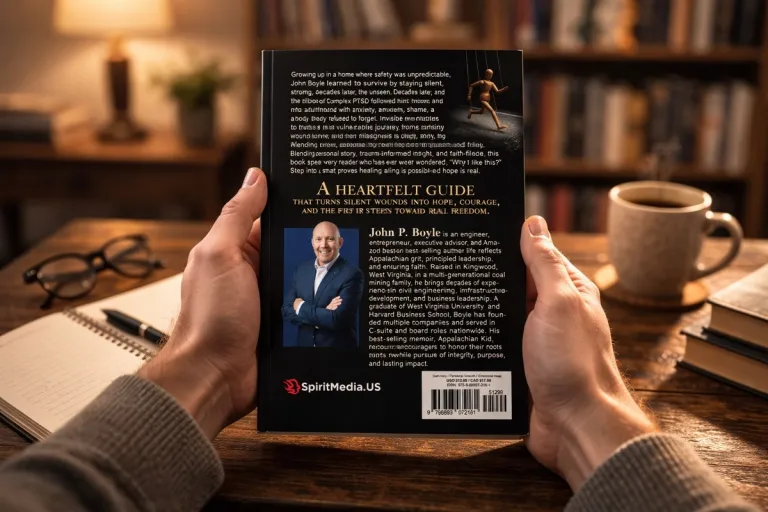
Whichever path you choose, the production quality bar has not moved. Christian readers buy fewer books per year than the average reader per Barna Group research, and they decide in seconds whether a book is worth their attention. Five elements have to be at trade-publishing level or the book fails to convert. Editorial: a developmental editor, a line editor, and a proofreader — three different roles, three different passes (see Reedsy's editor directory for the discipline distinctions). Cover: professionally designed by a cover designer who has shipped Christian trade titles, not a relative who took a graphic design class. Interior: typeset by a professional book designer, not run through a Word template (IngramSpark's print specs document why this matters at scale). Back cover: copy that turns a browse into a buy in roughly ten seconds. Read Your Book's Most Overlooked Sales Tool for what a back cover actually has to accomplish. Distribution: wide distribution through Ingram and Amazon, with metadata configured so the right readers can find it. A book that nails all five of these can be self-published; a book that misses two of them will struggle even with a Big Five imprint on the spine.
The Spirit Media hybrid path
Spirit Media Publishing is the hybrid path built specifically for ministry authors. Express Books is the fast-track lane — a single-author book of around 8,000 words, produced from an existing parent manuscript or interview corpus, ready in 60–90 days. It is the right vehicle when an author already has a longer book or body of teaching and wants a short, accessible doorway into it for new readers. Full-length books move through the full-spectrum publishing track: developmental editing, professional cover design, interior layout, distribution, and launch support. We don't take rights. We don't ration royalty share. We make production-quality publishing accessible to authors who would otherwise wait years for a traditional house or risk amateur production on their own. If you have a manuscript ready, a body of teaching that could become one, or a story that has been waiting for the right moment, the contact page is the first step. Read When a Stranger Finds Your Book for what happens nine months after launch when production quality and author platform combine.
A useful sanity check: any "Christian hybrid publisher" who asks $25,000+ without showing you a defined, line-item production scope (editorial passes, designer credits, distribution plan, launch deliverables) is a vanity press with new branding. Legitimate hybrid publishers write the scope down before you sign.
Common questions ministry authors ask
The five questions we hear most often from ministry authors considering publication, in order: (1) Do I need to be a published expert first? No — the bar is having a clear message and an audience willing to receive it; expertise builds through publication, not before it. (2) Can my book make money? Most Christian nonfiction books earn out their production cost within 18–24 months when production quality is trade-grade and the author has a real platform; the lifetime value of a strong book to a ministry is usually much higher than direct unit sales. (3) Will hybrid publishing hurt my credibility? Not in 2026 — the prestige gap closed in the last five years. Readers care about the book's quality, not the imprint on the spine. (4) What if I want to start with something shorter than a full book? Express Books is exactly that: an 8,000-word doorway to your fuller body of work, produced in 60–90 days. (5) How much of my time will it actually take? Plan on 80–120 author-hours for a full-length project (writing, editorial back-and-forth, marketing prep) over a 6–9 month window with a hybrid partner — substantially less than self-publishing alone, dramatically less than traditional after a 24-month wait.
What to do next
If you have a manuscript ready, a body of teaching that could become one, or a story that has been waiting for the right moment: contact us for a 30-minute conversation about scope, fit, and timeline. We will tell you honestly whether your project fits Express Books, the full-length track, or — if hybrid isn't the right fit for your situation — which traditional houses or self-publishing setups would serve you better. The publishing industry has changed substantially in the last decade. The path that fits your message and your audience exists somewhere; finding it is the first step.
Related pillar pages: Marketing a Christian Nonfiction Book · Christian Author Platform Building
_Continue reading: The Rise of AI-Powered Ministry Infrastructure · Your Book's Most Overlooked Sales Tool · When a Stranger Finds Your Book_