
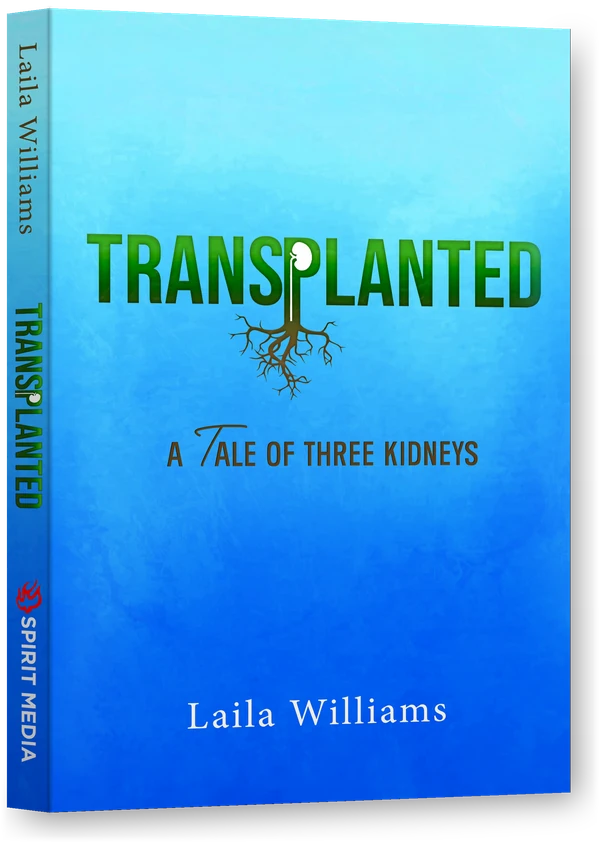
By Laila Williams
Transplanted
A Tale of Three Kidneys
For kidney patients, dialysis patients and their caregivers, living donors, and the families and friends who stand beside someone on the road to a transplant.
A caregiver's honest, practical and often funny account of one couple's road from kidney failure through dialysis to a living-donor transplant, written in everyday words by someone who has been through it.
15% off first order + free standard shipping to 223 countries
Afghanistan, Åland Islands, Albania, Algeria, Andorra, Angola, Anguilla, Antigua And Barbuda, Argentina, Armenia, Aruba, Australia, Austria, Azerbaijan, Bahamas, Bahrain, Bangladesh, Barbados, Belgium, Belize, Benin, Bermuda, Bhutan, Bolivia, Bosnia And Herzegowina, Botswana, Brazil, Brunei Darussalam, Bulgaria, Burkina Faso, Burundi, Cambodia, Cameroon, Canada, Cape Verde, Caribbean Netherlands, Cayman Islands, Central African Republic, Chad, Chile, China, Colombia, Comoros, Cook Islands, Costa Rica, Cote D'ivoire, Croatia (Local Name: Hrvatska), Curaçao, Cyprus, Czech Republic, Denmark, Djibouti, Dominica, Dominican Republic, Ecuador, Egypt, El Salvador, Equatorial Guinea, Eritrea, Estonia, Ethiopia, Falkland Islands (Malvinas), Faroe Islands, Fiji, Finland, France, French Guiana, French Polynesia, Gabon, Gambia, Georgia, Germany, Ghana, Gibraltar, Greece, Greenland, Grenada, Guadeloupe, Guam, Guatemala, Guernsey, Guinea, Guinea-Bissau, Guyana, Haiti, Holy See (Vatican City State), Honduras, Hong Kong, Hungary, Iceland, India, Indonesia, Iraq, Ireland, Isle of Man, Israel, Italy, Jamaica, Japan, Jersey, Jordan, Kazakhstan, Kenya, Kiribati, Kuwait, Kyrgyzstan, Lao People's Democratic Republic, Latvia, Lebanon, Lesotho, Liberia, Libyan Arab Jamahiriya, Liechtenstein, Lithuania, Luxembourg, Macao, Macedonia, The Former Yugoslav Republic Of, Madagascar, Malawi, Malaysia, Maldives, Mali, Malta, Martinique, Mauritania, Mauritius, Mayotte, Mexico, Moldova, Republic Of, Monaco, Mongolia, Montenegro, Montserrat, Morocco, Mozambique, Myanmar, Namibia, Nauru, Nepal, Netherlands, New Caledonia, New Zealand, Nicaragua, Niger, Nigeria, Niue, Norway, Oman, Pakistan, Palestinian Territory, Occupied, Panama, Papua New Guinea, Paraguay, Peru, Philippines, Pitcairn, Poland, Portugal, Puerto Rico, Qatar, Republic of Korea, Reunion, Romania, Rwanda, Saint Barthélemy, Saint Kitts And Nevis, Saint Lucia, Saint Martin, Saint Vincent And The Grenadines, Samoa, San Marino, Sao Tome And Principe, Saudi Arabia, Senegal, Serbia, Seychelles, Sierra Leone, Singapore, Sint Maarten, Slovakia (Slovak Republic), Slovenia, Solomon Islands, Somalia, South Africa, Spain, Sri Lanka, St. Helena, St. Pierre And Miquelon, Sudan, Suriname, Svalbard And Jan Mayen Islands, Swaziland, Sweden, Switzerland, Taiwan, Tajikistan, Tanzania, United Republic Of, Thailand, Timor-Leste, Togo, Tokelau, Tonga, Trinidad And Tobago, Tunisia, Turkey, Turkmenistan, Turks And Caicos Islands, Tuvalu, Uganda, Ukraine, United Arab Emirates, United Kingdom, United States, Uruguay, Uzbekistan, Vanuatu, Viet Nam, Virgin Islands (British), Wallis And Futuna Islands, Western Sahara, Yemen, Zambia, Zimbabwe
She met her husband on a church stage. Barely a year into their marriage, they were told to put him on the national transplant list.
“It is a harbor of hope for the ones who are tired and don’t think anyone understands.”
For kidney transplant patients, people on dialysis, living donors, spouses and caregivers, people waiting for a donor, transplant support groups, church care teams and the nurses and chaplains who serve them. Laila Williams says it plainly on the first pages: this is not a medical book. Your medical team will tell you everything medical. What she offers is what she needed and did not always have, someone who has been through it and will tell you what to expect, what was hard and what turned out better than hoped. The transplant was her husband's; the journey, she writes, was theirs. A note on subjects: the book describes kidney failure, dialysis at home, a surgery that went badly wrong before it went right, and the strain of illness on a marriage. It speaks of God's care and prayer, and it is written for any reader.
What makes this book for people on the transplant road
The introduction names what the author was missing when the journey began: a practical idea of how they were going to do things, from someone who would talk to her in normal everyday words. She wrote the book to be that person for the next family.
Five things set it apart:
- It is a caregiver's view. The transplant was her husband's, and Laila writes as the wife beside him through dialysis at home, a long surgery day and recovery, and she gives caregivers a chapter of their own.
- It is practical. Chapters cover types of dialysis and where it happens, juggling a job with treatment, joining the waiting list, insurance, Medicare and fundraising.
- It shows how to ask for a kidney. Chapter 7 describes what they tried, from a Facebook album to T-shirts with the donation details, and how their donor found them through social media.
- It tells the hard day honestly. Transplant day brought five bumps, from a fallen tree to a surgery stopped halfway, and the author does not smooth them over.
- It goes past the surgery. Part 3 covers recovery and four breakthroughs for life after transplant: medications, exercise, sleep and food. Part 4 covers counseling, peer support and care for the caregiver.
About the author
Written by
Laila Williams
Published by
 Spirit Media Publishing

Laila Williams
Laila Williams is a wife, caregiver and one half of what she calls Team Williams. She and her husband met on stage at their church during a midweek band rehearsal, where she played keys, and they married on that same stage fourteen months later. Both are degreed in engineering. She walked beside her husband through kidney failure, dialysis and a living-donor kidney transplant, and wrote Transplanted to be the encouragement she needed and did not have.
Spirit Media Publishing
Spirit Media Publishing is a Christian publishing and marketing company with a vision to reveal our Father's heart to all nations. It offers full-service book creation and publishing in paperback, hardback, digital and audiobook formats, along with children's titles, compact Express Books, website design and SEO, and podcast and video production. We are glad to publish a caregiver's honest story for families on the long road to a transplant.
What's inside
- An introduction, a preface, twenty-two chapters in four parts and a closing chapter, Wrapping Up
- Part 1, A Failing Body: the crisis, dialysis, work, the waiting list, finding a donor and paying for it all
- Part 2, A Serious Surgery: living wills and advance directives, pretesting, transplant day and recovery in three stages
- Part 3, And Then There's Life!: four breakthroughs for living after transplant, including four food guidelines
- Part 4, Support Through the Process: counseling, peer networks and caring for the caregiver
- Photos from the couple's journey, and short Pro Tip and Quick Time Out notes along the way
Product details
- Title
- Transplanted
- Paperback ISBN
- 978-1-958304-72-3
- Hardback ISBN
- 978-1-958304-73-0
- eBook ISBN
- 978-1-958304-75-4
- Audiobook ISBN
- 978-1-958304-74-7
- Subtitle
- A Tale of Three Kidneys
- Author
- Laila Williams
- Publisher
- Spirit Media Publishing
- Language
- English
- Pages
- 212
- Trim size
- 5.5 x 8.5 inches
- Binding
- Paperback (perfect bound) and hardback
- Publication date
- May 12, 2023
- Library of Congress Control Number
- 2023905651
For patients facing dialysis or transplant
If your kidneys are failing, the first chapters describe the crisis that started it for this couple: twenty-four pounds of fluid gained in less than seventy-two hours. Then come the decisions that follow, explained without medical jargon, by someone who made them at the kitchen table.
For spouses and caregivers
The author is frank about being tired, frustrated and then guilty about feeling frustrated. Don't Forget to Care for the Caregivers gives small, real ways to look after yourself, down to letting the dirty dishes wait so you can get another half hour of sleep.
For living donors and people searching for one
Chapter 6 explains who can donate and how to join the waiting list, and Chapter 7 is about promoting your need and asking. The book's donor appears throughout, feisty and funny, waking from her own surgery to ask how the recipient was doing.
For couples walking through illness
Chapter 19 tells how the couple found a Christian counselor with experience in chronic illness, and shares three take-aways: roles in a marriage sometimes need to shift for a time, even things you like can take a toll, and communication is key.
Three moments from the book
Five bumps on transplant day
The day began at 4 a.m. A storm dropped a tree across the donor's road minutes after she left. The lead surgeon was stuck in traffic. Then, an hour into surgery, the author's husband reacted to a drug, his blood pressure fell and the transplant was stopped, with the new kidney put on ice. Toxins built up, so he needed five hours of emergency dialysis. Just before 3 a.m. the next day, both surgeons came out to say it had worked. The author writes:
"Our transplant was not smooth. It had not gone according to plan. We still had a long road of recovery ahead of us."
The donor who would not give up her kidney to anyone else
Their donor found them by scrolling through Facebook and saw one of the author's posts. Before she finished reading, she commented that she would start the process of getting tested. On transplant day she woke from her own surgery and asked how the recipient was doing. Told that his part had not started yet, she let the staff know in no uncertain terms that the kidney was meant for him. The author writes of her:
"I also love our beautiful, wonderful, feisty donor for how she showed up during this time."
Why three kidneys
The last chapter explains the title. Three kidneys played the central roles: her husband's original two that were failing, and the transplanted one the couple calls Billy the Kid(ney). She adds a second reason she found by accident, the opening of A Tale of Two Cities, and says that is exactly what a transplant journey can feel like:
"It was the best of times, it was the worst of times."
Why this book exists
When the journey started, the author was overwhelmed with medical talk and short on encouragement. She wanted to hear from someone who had already come through it. The introduction says:
"I needed to see someone who had made it through and to believe that it really could be okay."
And then the reason for the book in one line:
"I'm hoping I can be that person for you."
Questions
What is Transplanted about?
It is a memoir and practical guide by Laila Williams about her husband's kidney failure, dialysis and living-donor kidney transplant, told from the caregiver's side. It covers the whole road, from the first crisis to life after transplant, in four parts.
Is it a medical book?
No. The author says so in the introduction. Your medical team gives the medical guidance. This book shares what one couple learned, what they wished they had known sooner and what helped, in everyday words.
Is it a good memoir for caregivers?
Yes. The author was her husband's caregiver through home dialysis and transplant, and she writes openly about exhaustion, frustration and guilt. Chapter 21, Don't Forget to Care for the Caregivers, gives small, practical ways to look after yourself.
Does it cover dialysis?
Yes. Chapter 2 covers types of dialysis, where it happens, training and supplies, and Chapter 3 covers juggling a job with dialysis. The couple did peritoneal dialysis at home, and transplant day brought an emergency round of hemodialysis.
Does it explain how to find a living kidney donor?
Yes. Chapter 6 covers who can donate and signing up for the waiting list, and Chapter 7, Finding Your Donor: Promote and Ask, shares what they tried, including social media, T-shirts and decals. Their own donor found them through Facebook.
Does it talk about counseling during a health crisis?
Yes. Chapter 19 tells how the couple chose a Christian counselor with experience in chronic illness and shares three take-aways. They are, in order:
- sometimes roles in a marriage need to shift for a time, and that's okay
- sometimes even things you like are going to take a toll, and that's when you get to let go of them
- communication is key
What is life like after a kidney transplant, according to the book?
Part 3 calls it And Then There's Life! It describes four breakthroughs. They are, in order:
- living with lifelong medications
- you get to focus on exercise
- get enough sleep and rest
- food, which is not all doom and gloom
The food chapter gives four guidelines, including avoiding buffets and controlling sodium.
Is Transplanted a Christian book?
It is written by a Christian and speaks of prayer and of God taking care of the couple, and they chose a counselor who shared their faith. Most of the book is practical and fits any reader on a transplant journey.