
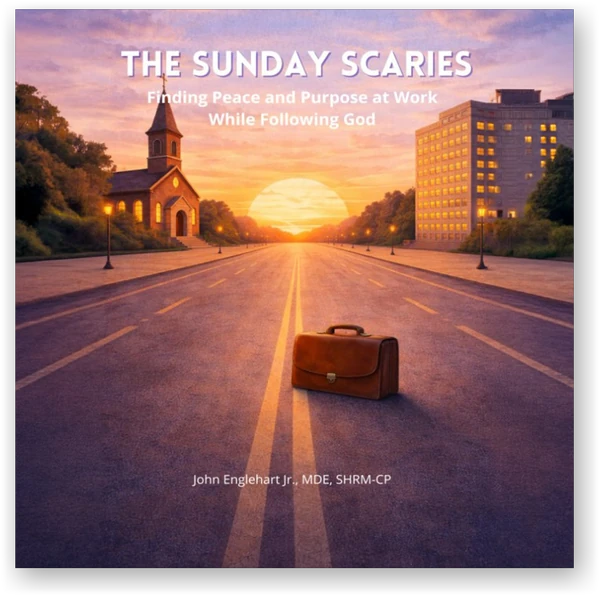
By John Englehart Jr.
The Sunday Scaries
Finding Peace and Purpose at Work While Following God
For Christians in secular jobs who dread Monday morning, for managers and HR professionals who want to keep Jesus at the center of their work, and for small groups that want to talk honestly about faith and work.
After fifteen years in human resources, John Englehart Jr. names the dread that shows up on Sunday evening and offers a simple, Scripture-rooted way to stay steady at work.
Audiobook
The Sunday Scaries
The Sunday Scaries is available as an audiobook.
Listen on Audible (opens in a new tab)Opens the Audible listing in a new tab.
An HR professional who has sat in his car on a Monday morning, praying through tears, writes for every believer who feels Sunday night in the stomach.
You can work in a secular world without becoming shaped by it.
For Christians who work in secular jobs and feel the pull between providing and trusting, for managers and HR professionals, for anyone who wonders whether ordinary work matters to God, and for small groups and Bible studies. John Englehart Jr. first heard the phrase "Sunday Scaries" at an HR conference and laughed, then realized he knew the feeling well. The book walks through a framework he calls STEADY, one letter per chapter, with stories from the Postal Service and from fifteen years in HR. A note on subjects: the book speaks plainly about anxiety, workplace gossip, burnout, King David's sin with Bathsheba, and the hard choice to leave a job. It says it is not medical, mental health, legal or professional advice, and that names and details in its stories have been changed and some characters are composites.
What makes this book for Christians in ordinary jobs
The book grew out of a conversation. A friend from church said, "I wish there were more books that encouraged people like us," people who work in secular jobs and try to keep Jesus first. The author's answer was two words: "Challenge accepted." He is careful to say the book is not a guilt trip, a sermon or a promise that work gets easy.
Five things set it apart:
- It is built on one framework, STEADY. Seek God First; Treat Your Work as Worship; Excel as If Working for the Lord; Add Value Where You Are; Demonstrate Christ Through Good Work; and Yield to Forgiveness, Mercy, and Grace. Chapters 3 through 8 take one letter each.
- It is written by someone who sits across the table. The author has worked in HR for fifteen years and started out as a mail carrier, and he tells stories from both, including the ones where he got it wrong.
- It uses Bible people who did ordinary work under pressure. Nehemiah served a king who did not share his faith, the apostle John was a fisherman, and the book points out that Jesus Himself was known as "the carpenter."
- It does not pretend. A chapter called Unsteady looks at King David's fall and gives a plain tool for mistakes: own it, learn from it, prevent it. It also says that verses about faithfulness at work are "not permission slips for abuse."
- It is made for groups. Every chapter ends with discussion questions and space to write, and three short frameworks, STEADY, GRACE and OLP, are collected at the back.
About the author
Written by
John Englehart
Published by
 Spirit Media Publishing

John Englehart
John Englehart Jr. has worked in human resources for fifteen years, and his byline lists the MDE and SHRM-CP credentials. He began his working life in 2000 as a U.S. mail carrier in Baltimore City. He writes that he is not seminary-trained but "a fellow disciple of Jesus Christ" who has spent years trying to study, love and live the Word, and he calls himself a teacher at heart. He started writing The Sunday Scaries during the holiday season of 2025.
Spirit Media Publishing
Spirit Media Publishing is a Christian publishing and marketing company with a vision to reveal our Father's heart to all nations. It offers full-service book creation and publishing in paperback, hardback, digital and audiobook formats, along with children's titles, compact Express Books, website design and SEO, and podcast and video production. We are glad to publish the audiobook of a book written for believers who carry their faith into Monday morning.
What's inside
- Ten chapters, from The Sunday Scaries to Monday Morning, with the STEADY framework at the center
- Discussion group questions at the end of every chapter, with space to write your answers
- Bible examples of steadiness and of losing it: Nehemiah, the apostle John, Jesus in Gethsemane and King David
- Three short frameworks at the back: STEADY, GRACE for hard conversations, and OLP for mistakes
- Workplace stories from the Postal Service and fifteen years in HR, told with humor, and an Author's Note on why he wrote it
- An audiobook edition from Spirit Media Publishing
Product details
- Title
- The Sunday Scaries
- Audiobook ISBN
- 979-8-89307-285-3
- Subtitle
- Finding Peace and Purpose at Work While Following God
- Author
- John Englehart
- Publisher
- Spirit Media Publishing
- Language
- English
- Format
- Audiobook
- Library of Congress Control Number
- 2026914681
For believers who dread Monday morning
If Sunday nights feel heavy, the author says plainly that this book is for you. He does not promise that you will love your job. He points to something deeper than job satisfaction: "Happiness is temporary and circumstantial. Joy runs deeper and stays steady." A pastor's line gave him a reboot he passes on: God is our eternal source, and our jobs are a temporary resource.
For managers, leaders and HR professionals
The author's note says what years in HR taught him: the way we treat people at work matters, and "Leadership has a human cost." In Chapter 5 he tells how, working in higher education during the pandemic, he replaced annual ratings with a twice-a-year coaching conversation he calls EXCELL. Chapter 7's GRACE framework gives five steps to run through before you speak in a hard conversation, starting with a pause and a short prayer: "Jesus, help me honor you here."
For small groups and Bible studies
Every chapter closes with four or five discussion questions, from when your Sunday Scaries show up to where you are resisting surrender this week. The author hopes the book "keeps going in your small groups, your Bible studies, your conversations over coffee," so that someone who says work is eating them alive is met with prayer and encouragement instead of shallow advice.
For anyone wondering whether to stay or go
Chapter 9 does not tell you to push through no matter what. It says sometimes the most faithful next step is admitting a workplace is shaping you in the wrong direction. It offers questions to ask before God, urges you to bring trusted voices into the decision, and states it simply: "Faithfulness doesn't mean staying trapped."
Three moments from the book
The mail truck and the Oldsmobile
In Chapter 3, the author is a new mail carrier in Baltimore City in 2000, in the last week of a ninety-day probation where one serious mistake meant you were gone. He misses a house, backs up the truck against the rules, and hits an older woman's car. She gets out, smiles and says, "Oh honey, I'm okay." Her husband had worked for the Post Office, there was no damage, and she drove away. Around that time an aunt had encouraged him to start each morning in prayer, so he prayed on every commute. His lesson is careful:
"Seeking God first doesn't always change the situation, but it changes who we're becoming inside it."
Did God get glory from that?
Chapter 4 tells of a coworker who was like a spiritual mother to him. When he told an off-color joke, she never shamed him. She asked one calm question, and he passes it on as a filter for emails, meetings and hallway talk:
"John, did God get glory from that?"
Then he admits a failure. In a meeting where gossip about two leaders crossed the line, he did not laugh, but he did not speak up either. He writes that silence is sometimes neutral, "but sometimes it becomes agreement."
The gas hose
In Chapter 9, a young, rushing mail carrier fills up his truck, grabs a soda and drives off with the gas hose still attached. He tries to jam it back into the pump, gives up and finishes his route. When his supervisor asks if he knows anything about it, he lies. The supervisor already knows, laughs, and tells him the real problem was the rushing. Then he gives the advice that became the book's tool for mistakes: own it, learn from it, prevent it. The author reports the result:
"I have never driven off with a gas hose again."
Why this book exists
It started with a friend from church who named a gap: encouragement for believers trying to follow Jesus faithfully in workplaces that do not naturally reinforce faith. In his Author's Note, he adds a second reason. After years in HR, he wanted to say out loud that the way we treat people at work matters. But the book, he writes, has a different aim than challenging leaders:
"My hope is that it shepherds believers."
He closes with a word for the week ahead:
"take a breath, say a prayer, and keep walking with Jesus."
Questions
What is The Sunday Scaries about?
It is a book for Christians who work in secular jobs and feel the dread that shows up as the weekend ends. John Englehart Jr., who has worked in HR for fifteen years, shows how to find peace and purpose at work while keeping Jesus at the center, using a framework he calls STEADY.
What is the STEADY framework?
They are, in order:
- Seek God First
- Treat Your Work as Worship
- Excel as If Working for the Lord
- Add Value Where You Are
- Demonstrate Christ Through Good Work
- Yield to Forgiveness, Mercy, and Grace
Chapters 3 through 8 take one each, and the framework is summarized again at the back of the book.
What Bible verses about work does the book use?
Many. Colossians 3:23, "work at it with all your heart, as working for the Lord," sits at the heart of the book, along with 1 Corinthians 10:31 on doing everything for the glory of God, Genesis 22:14 on the Lord who provides, and Proverbs 24:16 on rising again after a fall. Scripture is quoted from the New International Version.
Does it help with prayer at work?
Yes. Chapter 3, Seek God First, tells how the author began praying every morning on his commute, and the GRACE framework for hard conversations starts with a pause and a short prayer before you speak. The book is about putting God first before work starts demanding answers.
Is it about identity in Christ?
In part. The book says plainly that your job is not the source of your security, your identity, your joy or your worth, and that God is. It calls a job a temporary resource and God our eternal source.
Can a small group or a women's Bible study use it?
Yes. Every chapter ends with discussion group questions and space to write, and the author hopes the book keeps going in small groups and Bible studies. It is written for men and women alike, not for one group only.
Is it a devotional for men?
Not a daily devotional. It is ten chapters you can read straight through or one per group meeting. Men will recognize the stories from a man's working life, from a broken lawnmower at fourteen to a mail truck, but it is written for every believer in a secular job.
Does the book say to stay in a hard job no matter what?
No. Chapter 9 says sometimes the most faithful step is admitting an environment is shaping you in the wrong direction and letting go. It urges you to seek counsel first, and it says faithfulness at work is not permission for abuse, intimidation or unethical pressure.