
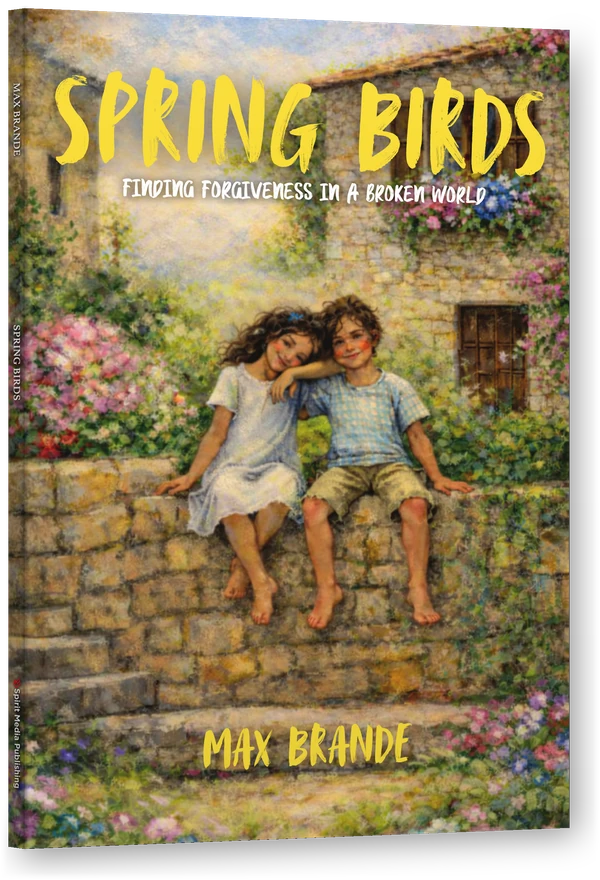
By Max Brande
Spring Birds
Finding Forgiveness in a Broken World
For readers of warm, faith-filled historical fiction, book clubs that like a story about mercy and forgiveness, and anyone who enjoys a small village, fresh bread and a long ride to the big city.
In a small Austrian village a baker named Big Leo refuses to fight when his emperor orders a military draft, and takes his praying wife and a wild-haired boy to Vienna, in a warm story about mercy, family and grace.
15% off first order + free standard shipping to 223 countries
Afghanistan, Åland Islands, Albania, Algeria, Andorra, Angola, Anguilla, Antigua And Barbuda, Argentina, Armenia, Aruba, Australia, Austria, Azerbaijan, Bahamas, Bahrain, Bangladesh, Barbados, Belgium, Belize, Benin, Bermuda, Bhutan, Bolivia, Bosnia And Herzegowina, Botswana, Brazil, Brunei Darussalam, Bulgaria, Burkina Faso, Burundi, Cambodia, Cameroon, Canada, Cape Verde, Caribbean Netherlands, Cayman Islands, Central African Republic, Chad, Chile, China, Colombia, Comoros, Cook Islands, Costa Rica, Cote D'ivoire, Croatia (Local Name: Hrvatska), Curaçao, Cyprus, Czech Republic, Denmark, Djibouti, Dominica, Dominican Republic, Ecuador, Egypt, El Salvador, Equatorial Guinea, Eritrea, Estonia, Ethiopia, Falkland Islands (Malvinas), Faroe Islands, Fiji, Finland, France, French Guiana, French Polynesia, Gabon, Gambia, Georgia, Germany, Ghana, Gibraltar, Greece, Greenland, Grenada, Guadeloupe, Guam, Guatemala, Guernsey, Guinea, Guinea-Bissau, Guyana, Haiti, Holy See (Vatican City State), Honduras, Hong Kong, Hungary, Iceland, India, Indonesia, Iraq, Ireland, Isle of Man, Israel, Italy, Jamaica, Japan, Jersey, Jordan, Kazakhstan, Kenya, Kiribati, Kuwait, Kyrgyzstan, Lao People's Democratic Republic, Latvia, Lebanon, Lesotho, Liberia, Libyan Arab Jamahiriya, Liechtenstein, Lithuania, Luxembourg, Macao, Macedonia, The Former Yugoslav Republic Of, Madagascar, Malawi, Malaysia, Maldives, Mali, Malta, Martinique, Mauritania, Mauritius, Mayotte, Mexico, Moldova, Republic Of, Monaco, Mongolia, Montenegro, Montserrat, Morocco, Mozambique, Myanmar, Namibia, Nauru, Nepal, Netherlands, New Caledonia, New Zealand, Nicaragua, Niger, Nigeria, Niue, Norway, Oman, Pakistan, Palestinian Territory, Occupied, Panama, Papua New Guinea, Paraguay, Peru, Philippines, Pitcairn, Poland, Portugal, Puerto Rico, Qatar, Republic of Korea, Reunion, Romania, Rwanda, Saint Barthélemy, Saint Kitts And Nevis, Saint Lucia, Saint Martin, Saint Vincent And The Grenadines, Samoa, San Marino, Sao Tome And Principe, Saudi Arabia, Senegal, Serbia, Seychelles, Sierra Leone, Singapore, Sint Maarten, Slovakia (Slovak Republic), Slovenia, Solomon Islands, Somalia, South Africa, Spain, Sri Lanka, St. Helena, St. Pierre And Miquelon, Sudan, Suriname, Svalbard And Jan Mayen Islands, Swaziland, Sweden, Switzerland, Taiwan, Tajikistan, Tanzania, United Republic Of, Thailand, Timor-Leste, Togo, Tokelau, Tonga, Trinidad And Tobago, Tunisia, Turkey, Turkmenistan, Turks And Caicos Islands, Tuvalu, Uganda, Ukraine, United Arab Emirates, United Kingdom, United States, Uruguay, Uzbekistan, Vanuatu, Viet Nam, Virgin Islands (British), Wallis And Futuna Islands, Western Sahara, Yemen, Zambia, Zimbabwe
A baker who will not fight, a praying wife and a wild-haired boy set out for Vienna.
The whole world could be at war, but that doesn't mean you have to be.
For readers of warm, faith-filled historical fiction, book clubs that like a story about mercy and forgiveness, and anyone who enjoys a small village, fresh bread and a long ride to the big city. In a short novel of twenty-four chapters, a barefoot baker called Big Leo refuses to take up arms for his emperor, and a boy who wants to know why grown-ups are always fighting gets an answer he does not expect. A note on subjects: this is a gentle story with a tender heart, but it does not look away from hard things. It includes drinking and a bar fight, a child who has been frightened by her father, a mother in despair, and a scene in which a public execution is carried out in front of a crowd. These are told without graphic detail, and the book answers them with kindness. If any of this is close to your own life, please talk to someone you trust. If you or someone you know is in danger or thinking about suicide, contact your local emergency services or a crisis line right away.
What makes this book for people who want a story of mercy
Spring Birds begins in a small village in Austria, at a yellow inn called the Heuriger, where beer, sausage and bread fill the air. From there it follows one family of three, a baker, his wife and a village boy, to the capital and into the lives of the people they meet on its streets. The emperor in the story is named Gier, and in Chapter 17 a character confirms the year as 1910.
Five things set it apart:
- It starts with a refusal. When officers arrive with a conscription order, Leo does not argue about politics. He simply says what he believes God wants of him, and he sits the officers down to eat.
- It is told through a child's questions. Max asks the question the whole book answers: why do grown-ups fight?
- It puts forgiveness in plain words. A wife and a baker teach a boy to love people who do wrong, and the book then tests that teaching on a stranger's street.
- It is funny. A teacher who calls a boy a loof, a grandmother who feeds blue birds at her window, a dough starter with a name and an emperor with a long neck all keep the mood light.
- It is short. Twenty-four brief chapters, about eighty pages, easy to read in a weekend.
About the author
Written by
Max Brande
Published by
 Spirit Media Publishing

Max Brande
Max Brande is the author of Spring Birds: Finding Forgiveness in a Broken World, a short novel in twenty-four chapters set in an Austrian village and in Vienna, published by Spirit Media Publishing in 2026.
Spirit Media Publishing
Spirit Media Publishing is a Christian publishing and marketing company with a vision to reveal our Father's heart to all nations. It offers full-service book creation and publishing in paperback, hardback, digital and audiobook formats, along with children's titles, compact Express Books, website design and SEO, and podcast and video production. We are honored to publish Max Brande's story of mercy and forgiveness.
What's inside
- Twenty-four short chapters about a baker, his wife and a boy
- A village inn, a cozy yellow cottage, a carriage ride, a smoky roadside tavern and a night sky full of stars
- A bakery below the street in Vienna, a flower shop, an old stone church on a hill and a walk to the palace
- A grandmother, an old royal baker, a street musician with a trumpet, a priest, and a mother and her silent daughter
- A prayer Leo says for the soldiers who came for him
- Paperback, about 80 pages, with an eBook edition
Product details
- Title
- Spring Birds
- Paperback ISBN
- 979-8-89307-263-1
- eBook ISBN
- 979-8-89307-264-8
- Subtitle
- Finding Forgiveness in a Broken World
- Author
- Max Brande
- Publisher
- Spirit Media Publishing
- Language
- English
- Pages
- 80 (paperback)
- Trim size
- 5.5 x 8.5 inches
- Binding
- Paperback (perfect bound, matte laminate), black and white interior, cream paper
- Library of Congress Control Number
- 2026910742
For readers of faith-filled historical fiction
This one has an emperor, a palace, an old city and an inn built in the 1600s, all seen through a boy's eyes. The faith in it is practical: people pray over a meal, bless a guest, ask a priest for help.
For book clubs
What does Leo owe an emperor, and what does he owe God? Is Rosina right that anyone can be reached by love? Why does Max keep asking? A short book, but a club will find plenty to discuss in how it treats people who are poor, drunk, proud or afraid.
For readers who love small villages, bread and food
Bread runs through every page. A baker lifts a fifty pound bag of flour and shows a boy how his starter stretches like a tongue. A basket of rolls with honey changes the mood of a standoff. A Vienna bakery changes hands in a day, and a soup the baker can never match is served in a cottage kitchen.
For anyone who finds it hard to forgive
The book does not make forgiveness sound easy. On his last morning in the village, Leo prays for the officers who came to draft him, and Max wants to know why. Leo's answer is short:
"Being hateful is exhausting. Also, they are my brothers."
The rest of the story tests that answer, first in a roadside tavern fight and then on a man in Vienna whose own daughter is afraid of him.
Three moments from the book
Rolls and honey
Three men in uniform come to the hotel with a letter of military orders. Leo does not take it. He tells them plainly that "God doesn't want me to fight you or anyone else." One of the soldiers, an old friend, shrugs and apologizes. Another quietly empties the basket of rolls. Leo offers him more: "It's great with a drop of honey." Then he invites all three to the bar for coffee, because "I know you haven't had anything." The officer, careful not to look too pleased, asks how long Leo has been a baker, and the standoff turns into a new offer. Leo sums it up with a dry line: "A minute ago you wanted me to kill people, and now you want me to feed people."
A trumpet in the alley
One night soon after reaching Vienna, Leo lies awake listening to the city and hears a trumpet in the alley below. "It sounded honest and sad. There was a humble pain in it." The next morning he meets the man who played it, a street musician who has been told his music is too slow. Leo does not tell him to change. He says, "I heard you play at night, my friend. It was truly beautiful." Leo offers an idea that is also a blessing: "God's an artist, you're a musician, and I'm a baker."
Two children in a meadow
A girl with a flower in her hair has never been heard to speak. When she meets Max, he takes the flower she offers and leads her out of the city to a green meadow. "It looked like two does were meeting each other." They lie on their backs and watch the clouds. When Max starts walking through the flowers, she speaks, and the book marks it plainly: "Don't step on the flowers." Max is not surprised. He thinks her voice is pretty.
Why this book exists
What the story itself says is plain. Its first question comes from a boy: "Do I have to fight when I grow up?" Its answer comes from a wife who prays: "The whole world could be at war, but that doesn't mean you have to be."
Leo's prayer in Chapter 4 says the same thing in his own words, on the morning he leaves home:
"Holy Father, Forgive my sins, Forgive the soldiers as I forgive them, Bless them, And bless my marriage"
Questions
What is Spring Birds about?
A baker named Big Leo in a small Austrian village refuses to fight when his emperor orders a military call-up. He, his praying wife Rosina and a wild-haired boy named Max travel to Vienna, and the story asks why grown-ups fight and answers with love and forgiveness.
Is it historical fiction?
Yes, it is classed as historical fiction and Christian fiction. It is set in an Austrian village and in Vienna, with a fictional emperor named Gier, and in Chapter 17 a character gives the year as 1910.
Is it a story about a conscientious objector?
In effect, yes. The opening premise is that Leo refuses military service because he believes God does not want him to fight anyone. The words conscientious objector do not appear in the book. Leo's reason is his faith, he states it calmly, and the book follows what happens next.
What does the book say about loving your enemies?
Rosina tells Max that we are taught to love everyone and forgive everyone, and Leo prays for the soldiers who came for him. He tells Max that "Being hateful is exhausting. Also, they are my brothers." The phrase love your enemies is not in the book, but the idea runs through it.
Is it a heartwarming novel?
Yes. It is a warm, faith-filled story about mercy, family and grace, and much of it is funny. It also contains hard moments, and the note on subjects near the top says what they are.
What does the title Spring Birds mean?
The phrase appears in Chapter 10, where Rosina walks down a Vienna street and everyone she smiles at is happy for a while after. "She was pleasant like spring birds, innocent like their songs." Blue birds also gather at the window of Max's grandmother's kitchen in Chapter 2.
What does the book say about forgiveness?
Rosina tells Max to love people who do wrong and forgive them so there is no evil in his heart. Later in the book, forgiveness is asked for and given by people who have good reason to withhold it.
How long is it, and who is it for?
It is about eighty pages in twenty-four short chapters, for adult and teen readers who like warm historical fiction. Parents of younger readers should read the note on subjects first.