
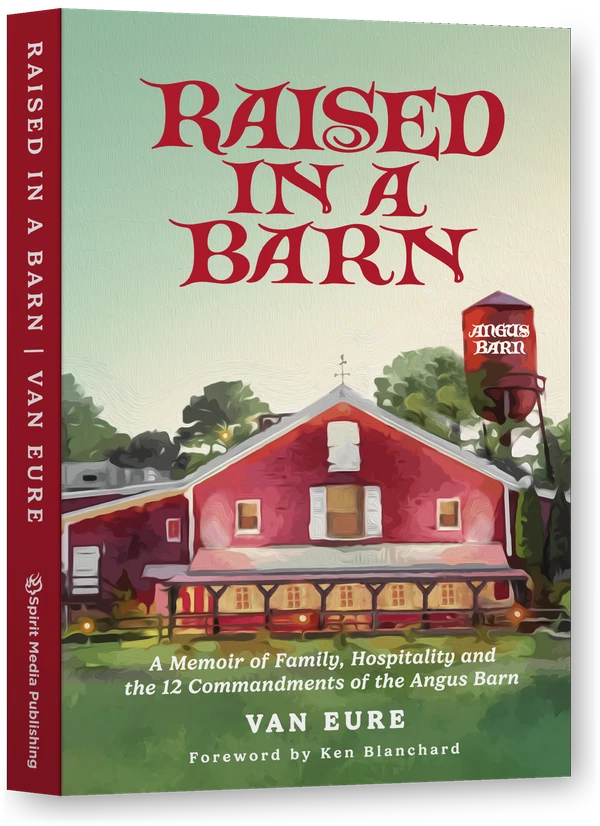
By Van Eure · Foreword by Ken Blanchard
Raised in a Barn
A Memoir of Family, Hospitality, and the 12 Commandments of the Angus Barn
For restaurant owners and managers, business and team leaders in any field, anyone who serves people for a living, and readers who love a funny, honest family memoir with a Southern voice.
Angus Barn leader Van Eure shares the funny, heartfelt stories and 12 Commandments behind one of the highest-grossing independent restaurants in the United States.
15% off first order + free standard shipping to 223 countries
Afghanistan, Åland Islands, Albania, Algeria, Andorra, Angola, Anguilla, Antigua And Barbuda, Argentina, Armenia, Aruba, Australia, Austria, Azerbaijan, Bahamas, Bahrain, Bangladesh, Barbados, Belgium, Belize, Benin, Bermuda, Bhutan, Bolivia, Bosnia And Herzegowina, Botswana, Brazil, Brunei Darussalam, Bulgaria, Burkina Faso, Burundi, Cambodia, Cameroon, Canada, Cape Verde, Caribbean Netherlands, Cayman Islands, Central African Republic, Chad, Chile, China, Colombia, Comoros, Cook Islands, Costa Rica, Cote D'ivoire, Croatia (Local Name: Hrvatska), Curaçao, Cyprus, Czech Republic, Denmark, Djibouti, Dominica, Dominican Republic, Ecuador, Egypt, El Salvador, Equatorial Guinea, Eritrea, Estonia, Ethiopia, Falkland Islands (Malvinas), Faroe Islands, Fiji, Finland, France, French Guiana, French Polynesia, Gabon, Gambia, Georgia, Germany, Ghana, Gibraltar, Greece, Greenland, Grenada, Guadeloupe, Guam, Guatemala, Guernsey, Guinea, Guinea-Bissau, Guyana, Haiti, Holy See (Vatican City State), Honduras, Hong Kong, Hungary, Iceland, India, Indonesia, Iraq, Ireland, Isle of Man, Israel, Italy, Jamaica, Japan, Jersey, Jordan, Kazakhstan, Kenya, Kiribati, Kuwait, Kyrgyzstan, Lao People's Democratic Republic, Latvia, Lebanon, Lesotho, Liberia, Libyan Arab Jamahiriya, Liechtenstein, Lithuania, Luxembourg, Macao, Macedonia, The Former Yugoslav Republic Of, Madagascar, Malawi, Malaysia, Maldives, Mali, Malta, Martinique, Mauritania, Mauritius, Mayotte, Mexico, Moldova, Republic Of, Monaco, Mongolia, Montenegro, Montserrat, Morocco, Mozambique, Myanmar, Namibia, Nauru, Nepal, Netherlands, New Caledonia, New Zealand, Nicaragua, Niger, Nigeria, Niue, Norway, Oman, Pakistan, Palestinian Territory, Occupied, Panama, Papua New Guinea, Paraguay, Peru, Philippines, Pitcairn, Poland, Portugal, Puerto Rico, Qatar, Republic of Korea, Reunion, Romania, Rwanda, Saint Barthélemy, Saint Kitts And Nevis, Saint Lucia, Saint Martin, Saint Vincent And The Grenadines, Samoa, San Marino, Sao Tome And Principe, Saudi Arabia, Senegal, Serbia, Seychelles, Sierra Leone, Singapore, Sint Maarten, Slovakia (Slovak Republic), Slovenia, Solomon Islands, Somalia, South Africa, Spain, Sri Lanka, St. Helena, St. Pierre And Miquelon, Sudan, Suriname, Svalbard And Jan Mayen Islands, Swaziland, Sweden, Switzerland, Taiwan, Tajikistan, Tanzania, United Republic Of, Thailand, Timor-Leste, Togo, Tokelau, Tonga, Trinidad And Tobago, Tunisia, Turkey, Turkmenistan, Turks And Caicos Islands, Tuvalu, Uganda, Ukraine, United Arab Emirates, United Kingdom, United States, Uruguay, Uzbekistan, Vanuatu, Viet Nam, Virgin Islands (British), Wallis And Futuna Islands, Western Sahara, Yemen, Zambia, Zimbabwe
The woman who has led the Angus Barn since 1988 opens her memoir stuck under a bathroom stall door, and then shows how the restaurant is run.
“Sometimes you think you can fit, and sometimes you absolutely cannot.”
For restaurant owners and managers, business and team leaders in any field, anyone who serves people for a living, and readers who love a funny, honest family memoir with a Southern voice. Van Eure tells how two former college football players with no restaurant training opened a steakhouse on Highway 70 in Raleigh, North Carolina, in 1960, and how the 12 Commandments her team has worked by for over twenty-five years grew out of real people and real mistakes. Ken Blanchard wrote the foreword. A note on subjects: the book is warm and funny, and it is written for adults. It uses some strong language, including a few swear words, and the opening story is a body-humor scene in a restroom. It also touches on a father and daughter who struggled to know each other, on the death of a parent, and on mental illness research. It is a memoir and a leadership book, not a how-to for starting a restaurant.
What makes this book for people who serve people
The book opens with a woman stuck in a restaurant restroom and the owner, Van, who tries to help and gets stuck herself. A server named Debbie arrives and slides under the door like it is no big deal. That story sets the tone for everything that follows: hospitality is not polish, it is what you do when things go wrong.
Five things set it apart:
- It is a memoir and a leadership book at once. The first three chapters tell the family story: the founding, a speech her father gave in 1986, and how she came to lead the Barn. Chapters 4 through 15 take one commandment at a time.
- Every commandment comes with a story. The 20-Foot Rule is a seafood station and a cook named Raymond. The recovery chapter starts with a five-pound lobster that did not arrive.
- It is built on three values: Integrity, Teamwork and Excellence. The book says these are woven into the commandments, the stories and the whole culture of the Barn.
- It has real numbers. One location, more than five hundred people, over 350,000 guests every year, a wine cellar of more than 28,000 bottles, and the Wine Spectator Grand Award every year since 1989.
- It ends with the Barn's own mission and with the people who carry it forward, with a scrapbook of family and team photos at the back.
About the author

Van Eure
Van Eure has led the Angus Barn in Raleigh since her father's death in 1988, and she began working there at the age of seven. After a mountain-climbing trip to Kenya, she stayed for five years teaching school before returning home. Under her leadership the Barn has become one of the highest-grossing independent restaurants in the United States, and the book says its turnover rate of 16.5 percent leads some to joke that "it's easier to get a job with the FBI." Her honors include the National Restaurant Association's Industry Legends Award in 2019, and she chairs Walk for Hope, which has helped raise more than $150 million for mental health research. Raised in a Barn is her first book.
Spirit Media Publishing
Spirit Media Publishing is a Christian publishing and marketing company with a vision to reveal our Father's heart to all nations. It offers full-service book creation and publishing in paperback, hardback, digital and audiobook formats, along with children's titles, compact Express Books, website design and SEO, and podcast and video production. We are glad to publish the story of a family restaurant and the people who keep it going.
What's inside
- A prologue, an introduction, sixteen chapters and a conclusion, The Story Continues as It's Carried Forward
- The 12 Commandments, from You Are Who You Hire to Reach Out & Lift Up, each with its own chapter and a real story
- A foreword by Ken Blanchard, coauthor of The One Minute Manager and Raving Fans
- Advance praise from a television news leader, a former ambassador, a theater founder, a country music star, a bestselling author and a medical school dean
- An About the Author page and scrapbook photos, from the Barn's early years to the present
- A paperback with a memoir voice and stories you can read one at a time
Product details
- Title
- Raised in a Barn
- Paperback ISBN
- 979-8-89307-302-7
- Hardback ISBN
- 979-8-89307-303-4
- eBook ISBN
- 979-8-89307-304-1
- Audiobook ISBN
- 979-8-89307-305-8
- Subtitle
- A Memoir of Family, Hospitality and the 12 Commandments of the Angus Barn
- Author
- Van Eure
- Foreword
- Ken Blanchard
- Publisher
 Spirit Media Publishing
- Language
- English
- Trim size
- 5.5 x 8.5 inches
- Binding
- Paperback (perfect bound)
- Library of Congress Control Number
- 2026917991
For restaurant owners and managers
If you run a place where people eat, you will recognize the nights the book describes: everything goes right, or everything falls apart in thirty seconds. Van says plainly that you will never reach perfection in this business, and that what counts is what you do next. Each commandment is a habit you can bring to a pre-shift meeting.
For business and team leaders in any field
The stories happen in a steakhouse, and the lessons travel. Ask the person closest to the problem. Put "we" before "me." Keep learning. Take care of your people. The foreword calls the best leaders servant leaders, and the book gives examples from the kitchen, the front desk and the parking lot.
For readers who love a family memoir
The first chapters are a family story: a founding in 1960, a grandfather who put his house up as collateral, a father who coached little league like it was the NFL and a daughter who finally got to know him. It is funny, and it is also tender.
For anyone in a job that serves others
You do not need a dining room, a title or a uniform. Van writes that you just need the awareness to notice when someone needs help and the willingness to step in. That fits a nurse, a teacher, a pastor, a hotel clerk or a volunteer.
Three moments from the book
The bathroom rescue
A guest with a hip replacement cannot get off the toilet in a restroom stall. Her granddaughter finds Van, who thinks she can slide under the door and help. She cannot. Now two people are stuck. Van calls for Debbie, a server who is "teeny," who slides under the door, helps the woman up, and then helps Van get free. The lesson she takes from it is not about restrooms:
"Sometimes you think you can fit, and sometimes you absolutely cannot."
The seafood station
In Chapter 7, Van is apologizing to a private group of twenty because the seafood did not come out with the rest of the entrees. The menu had grown over the years, but one person still handled all the seafood. She sits down with the sauté cook, the line cooks and the servers. They think they are in trouble.
"Nobody is in trouble. I need your help."
Raymond, one of the cooks, answers with an idea: a seafood station at each grill. It cost $60,000 and fixed the problem. The rule is not a measurement. It means asking the people who work closest to the problem. The chapter adds a story about consultant Tom Peters, who walked down four flights of stairs and asked one person why people did not stay.
The lobster that did not arrive
Chapter 11 tells of a couple who had come to the Barn for thirty years to celebrate, always ordering a five-pound lobster a week ahead. One year the host got the date wrong. The kitchen plated five one-pound lobsters, and a chef explained exactly what happened. They were still unhappy, so Van learned they were leaving for Jamaica the next day. When they came back, the Barn met them at the airport and brought them straight to the restaurant, where a chef cooked the five-pound lobster. The book states the principle:
"What you do in the next thirty seconds is where character lives."
Why this book exists
The seed was planted years ago. In A Word of Thanks, Van writes that one of her managers, Jefferson Napier, "wrote a whole manuscript about our 12 Commandments" twenty-five years earlier, believing a book about the way they do things would help other businesses. She did not take it further then. Now she writes:
"I do see the value in sharing these basic principles."
The prologue says what she wants the reader to take from it:
"Most of what I know didn't come from a book. It came from moments like this."
Questions
What is Raised in a Barn about?
It is a memoir by Van Eure, who has led the Angus Barn restaurant in Raleigh, North Carolina, since 1988. She tells the story of the Barn's founding in 1960, the father she finally came to know and love, how she came to lead the family business, and the 12 Commandments her team works by.
What is the Angus Barn?
The Angus Barn opened in 1960 on Highway 70 in Raleigh and still operates from that one location. The book says it employs more than five hundred people, serves over 350,000 guests every year and has received the Wine Spectator Grand Award every year since 1989. It was founded by Van's father and his partner, Charles Winston, who had no restaurant training.
What are the 12 Commandments of the Angus Barn?
They are, in order:
- You Are Who You Hire
- Serve Your Team
- We Before Me
- The 20-Foot Rule
- Just OK Is Not OK
- The Customer Is Always the Paying Customer
- Serving Is a Privilege
- It's Not the Mistake, It's the Recovery
- Never Stop Learning
- Be There
- Keep the Main Thing the Main Thing
- Reach Out & Lift Up
Each has its own chapter, from 4 to 15.
Is it one of the good memoir books for people in business?
Yes. It is a personal story with a business lesson on nearly every page, and the author says plainly that these are "lessons carved out of real experience." The word memoir appears on the cover, and the stories come from family, staff and guests.
Is it one of the hospitality books worth reading for restaurant owners?
It is written by a restaurant leader for people who serve customers. Hospitality is the central idea, and the book defines it as what shows up when things go wrong. It is a book of stories and principles, not a start-up guide.
Does it cover North Carolina history?
Some of it. The opening chapters describe Raleigh and Highway 70 when it was a two-way country road, and Van's grandfather Thad Eure Sr. served as North Carolina's Secretary of State for fifty-three years. It is a family and restaurant story first, not a history of the state.
Does the book cover customer service and servant leadership?
Yes. Serve Your Team, Serving Is a Privilege and The Customer Is Always the Paying Customer each have a chapter. Ken Blanchard, who wrote the foreword, writes that the best leaders are servant leaders.
Does the book contain strong language?
A little. A few swear words appear in the stories, starting with the bathroom rescue, and the tone is conversational and humorous. Readers who prefer none should know that before they begin.