
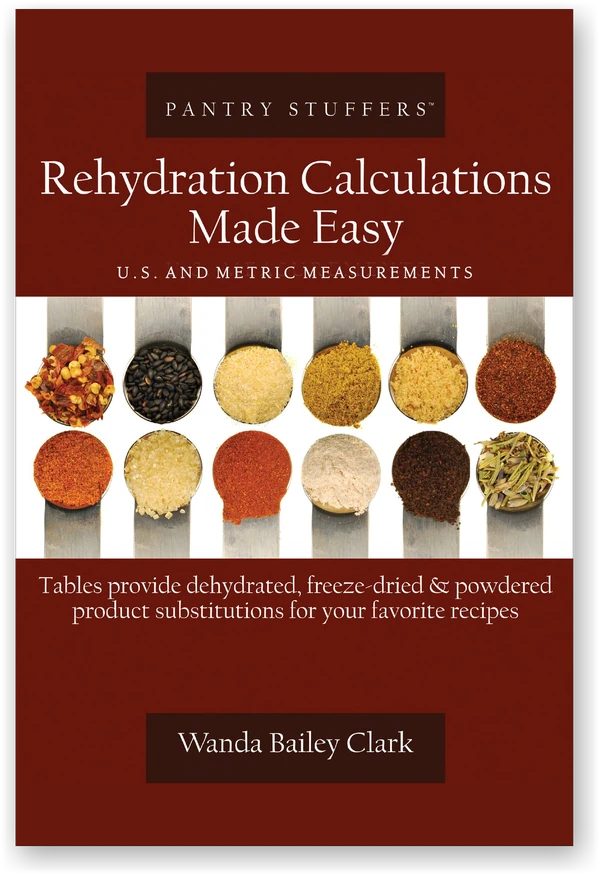
By Wanda Bailey Clark
Pantry Stuffers Rehydration Calculations Made Easy
Dehydrated, Freeze-Dried, and Powdered Ingredients in U.S. and Metric Measurements
For home cooks who keep dehydrated, freeze-dried and powdered foods on hand, whether for long-term food storage, emergencies or simply fewer trips to the store.
A quick-reference chart book that answers one question for hundreds of shelf-stable ingredients: how much dry product and how much water to add.
eBook
Pantry Stuffers Rehydration Calculations Made Easy
Pantry Stuffers Rehydration Calculations Made Easy is available as an eBook.
Buy the eBook (opens in a new tab)Opens the Kindle listing in a new tab.
A grandmother with a passion for preparedness wrote down the answer she kept needing: how much product, and how much water.
“The amount of water needed to reconstitute products is based on how much water was removed during the dehydration, freeze-drying, or powder process.”
For home cooks building a pantry of shelf-stable food, families who keep supplies for emergencies, and anyone who would rather reach for dried vegetables than make a last-minute run to the grocery store. Wanda Bailey Clark started cooking with dehydrated, freeze-dried and powdered ingredients several years ago. She now packages mixes for convenience and disaster support and keeps her pantry stuffed. This book is the tool she made for herself. It opens with a short explanation of how each drying process works and what happens to nutrition, then gives chart after chart, one entry per product. It is a reference, not a cookbook of recipes, and not a guide to building a storage plan. The U.S. charts are rounded to the nearest 1/4 teaspoon.
What makes this book for people who cook from the pantry
Every product dries differently, so every product needs a different amount of water. Wanda writes that reconstitution is different product to product, and the book is built around that fact: you look up the item, and the chart tells you how much dry product, how much water and how much ready-to-use food you will get.
Five things set it apart:
- Each entry is one simple formula. For example, dehydrated carrots: 1 cup carrots plus 2 cups water makes 4 cups carrots.
- It covers the whole pantry. Vegetables from asparagus to zucchini, freeze-dried fruits and berries, dehydrated and dried beans, textured vegetable protein, freeze-dried meats, cheeses, eggs and dairy, fruit juice powders, sauces, syrups and wine powders.
- It separates dehydrated from freeze-dried. The same vegetable often appears twice, because the two processes take different amounts of water and give different yields.
- It starts with the basics. A short opening section explains dehydration, freeze-drying and powdering, and what happens to vitamins and minerals in each.
- It includes the small helps. A list of garlic substitutions for one clove, egg and cream cheese conversions, and soaking directions for dried beans with a list of forty varieties.
About the author
Written by
Wanda Bailey Clark
Published by
 Spirit Media Publishing

Wanda Bailey Clark
Wanda Bailey Clark is a busy suburban wife, mother and grandmother with a passion for preparedness. Although she had long known that dehydrated, freeze-dried and powdered ingredients existed, she began using them only several years ago. Today she packages mixes for convenience and disaster support, keeps her pantry stuffed to avoid last-minute trips to the grocery store, and keeps a supply as a nutritious alternative to out-of-season vegetables. She dedicates her work first to Jesus Christ, her Lord and Savior.
Spirit Media Publishing
Spirit Media Publishing is a Christian publishing and marketing company with a vision to reveal our Father's heart to all nations. It offers full-service book creation and publishing in paperback, hardback, digital and audiobook formats, along with children's titles, compact Express Books, website design and SEO, and podcast and video production. We are glad to publish a practical kitchen reference that helps families care for one another.
What's inside
- The Basics: dehydration, freeze-drying, the powder process and nutritional value
- Charts for vegetables and freeze-dried fruits and berries, with dehydrated and freeze-dried versions listed separately
- Dehydrated beans and legumes, plus dried beans with soaking directions and a list of forty varieties
- Textured vegetable protein, freeze-dried meats, cheeses and cheese sauce powders
- Powdered eggs, milk, buttermilk, heavy cream, butter, sour cream and cream cheese
- Fruit juice powders, honey, peanut butter, soy sauce, vinegar, maple syrup and wine powders
Product details
- Title
- Pantry Stuffers Rehydration Calculations Made Easy
- eBook ISBN
- 979-8-89307-255-6
- PDF ISBN
- 979-8-89307-256-3
- Subtitle
- Dehydrated, Freeze-Dried, and Powdered Ingredients in U.S. and Metric Measurements
- Author
- Wanda Bailey Clark
- Publisher
- Spirit Media Publishing
- Publication date
- March 20, 2026
- Language
- English
- Formats
- eBook and PDF (digital editions)
- Pages
- 133 (PDF)
- Library of Congress Control Number
- 2026906875
For home cooks building long-term food storage
If you keep a shelf of dried and freeze-dried products, the hard part is often using them in everyday cooking. The charts turn each product into an amount you can measure, so dried and freeze-dried foods can go into regular meals instead of waiting on a shelf.
For families preparing for emergencies
Wanda packages mixes for disaster support. When the power is out or the stores are empty, there is no time to search for the right ratio. This book keeps the answer in one place for vegetables, proteins, dairy and staples like milk and eggs.
For anyone who wants fewer trips to the store
Out of milk, eggs or sour cream halfway through a recipe? The book was written to meet that exact need. Wanda says its purpose is the last-minute substitution: how much product and how much water to add.
For cooks who want vegetables out of season
She keeps a supply as a nutritious alternative to out-of-season vegetables. The opening section explains that most vitamins and minerals stay intact during dehydration, except vitamin C, and that dehydration keeps more of them than canning or freezing.
Three pages from the book
One egg, from powder
The Eggs & Dairy section gives the amounts as a single egg, the way most recipes call for them:
"1 egg = 2 TBS whole egg powder with 3 TBS of water"
Egg whites take equal parts powder and water. The same section shows how to make 3 ounces or 8 ounces of cream cheese from powder.
Dried beans, start to finish
Dehydrated beans go straight to water. Dried beans are different, and the book explains the steps: cover them with two inches of water, soak at least two hours, pour off the soaking water, add fresh water and cook. It adds a rule of thumb:
"As a general rule, one cup of dried beans will produce three cups of cooked beans."
When the recipe calls for a clove of garlic
Tucked into the vegetable charts is a short list of what equals one clove of garlic. They are, in order: 1 tsp chopped garlic; 1/2 tsp minced garlic; 1/8 tsp garlic powder; 1/2 tsp garlic flakes; 1/4 tsp granulated garlic; and 1/2 tsp garlic juice. It is the kind of answer you need in the middle of cooking, and the reason the book exists.
Why this book exists
Wanda kept running into the same problem in her own kitchen, especially when she needed a substitution in a hurry. In the Reconstitution page she names it plainly: how much product and how much water to add. She made the reference she wished she had, and she hopes it helps others as they bring dried products into their own pantries:
"I hope that this book becomes a valuable tool to you, too …"
Questions
What does Pantry Stuffers Rehydration Calculations Made Easy cover?
It is a chart reference for shelf-stable dehydrated, freeze-dried and powdered foods. Each entry gives the amount of dry product and water and the amount of ready-to-use food it makes. It covers vegetables, fruits, beans and legumes, textured vegetable protein, freeze-dried meats, cheeses, eggs and dairy, juice powders, sauces, syrups and wine powders.
How much water do you add to powdered milk?
The book's chart says 1/4 cup milk powder plus 1 cup water makes 1 cup milk. It also charts buttermilk, heavy cream, sour cream, butter, margarine and cream cheese powders.
Does it cover textured vegetable protein (TVP)?
Yes. TVP has its own section with eleven kinds, from plain to bacon bits, beef chunks, chicken, ham, pepperoni, sausage, sloppy joe mix and taco bits. Plain TVP is 1 cup TVP plus 2 cups water for 2 1/4 cups.
How do you use egg powder?
For one egg, the book says to use 2 tablespoons of whole egg powder with 3 tablespoons of water. For egg whites, it is 2 tablespoons of egg white powder with 2 tablespoons of water.
Does it include peanut butter powder?
Yes. It lists 3 tablespoons of peanut butter powder plus 2 teaspoons of water for 1 tablespoon of peanut butter, with sugar and oil added to taste. Peanut butter is one entry in a section of pantry powders that also includes honey, shortening, soy sauce, teriyaki, vinegar, Worcestershire and maple syrup.
Is it an emergency food and food storage book?
It is written by someone who packages mixes for disaster support and keeps a stocked pantry, and it helps you cook with the dried foods you store. It does not tell you what to store or how much. It is a calculation companion, not a storage plan.
Does it explain how to cook dried beans?
Yes. It separates dehydrated beans and legumes, which do not need pre-soaking, from dried beans, which need to be pre-soaked. For dried beans it says to cover them with two inches of water, soak at least two hours, drain, add fresh water and cook, and that one cup of dried beans makes about three cups cooked.
Is it a kitchen conversion chart?
Not a general one. It does not convert cups to ounces or Fahrenheit to Celsius. It answers how much water to add to each dried, freeze-dried or powdered product, with the U.S. amounts rounded to the nearest 1/4 teaspoon.
Does it explain food preservation methods?
Briefly. The Basics section explains dehydration, the oldest form of food preservation, along with freeze-drying and the powder process, and what each does to vitamins and minerals. The rest of the book is charts.