
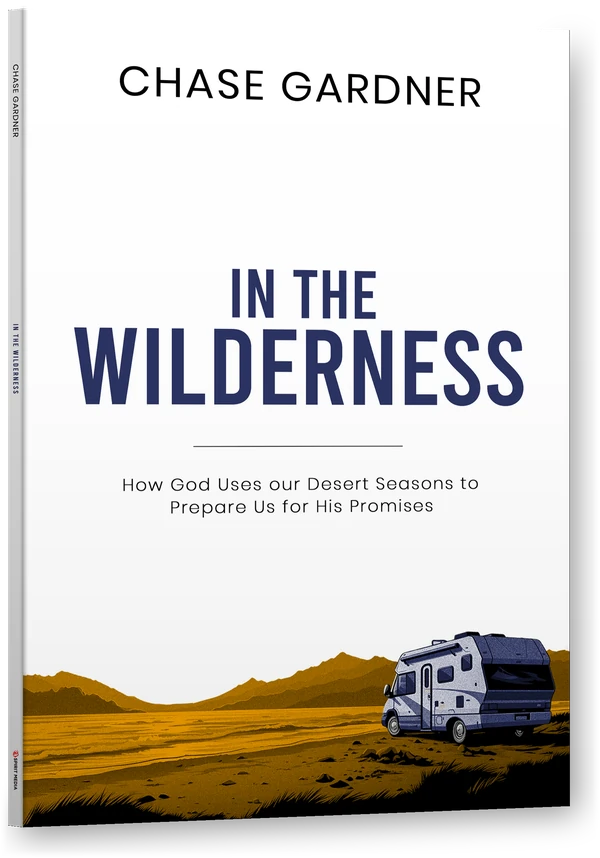
By Chase Gardner
In The Wilderness
How God Uses Our Desert Seasons to Prepare Us for His Promise
For Christians in a hard or confusing season, believers waiting on a promise from God, and pastors and small groups studying the wilderness stories of the Old Testament.
Through the wilderness stories of Israel, Abraham, Jacob and Moses, pastor Chase Gardner shows how God uses our desert seasons to speak to us and prepare us for His promises.
15% off first order + free standard shipping to 223 countries
Afghanistan, Åland Islands, Albania, Algeria, Andorra, Angola, Anguilla, Antigua And Barbuda, Argentina, Armenia, Aruba, Australia, Austria, Azerbaijan, Bahamas, Bahrain, Bangladesh, Barbados, Belgium, Belize, Benin, Bermuda, Bhutan, Bolivia, Bosnia And Herzegowina, Botswana, Brazil, Brunei Darussalam, Bulgaria, Burkina Faso, Burundi, Cambodia, Cameroon, Canada, Cape Verde, Caribbean Netherlands, Cayman Islands, Central African Republic, Chad, Chile, China, Colombia, Comoros, Cook Islands, Costa Rica, Cote D'ivoire, Croatia (Local Name: Hrvatska), Curaçao, Cyprus, Czech Republic, Denmark, Djibouti, Dominica, Dominican Republic, Ecuador, Egypt, El Salvador, Equatorial Guinea, Eritrea, Estonia, Ethiopia, Falkland Islands (Malvinas), Faroe Islands, Fiji, Finland, France, French Guiana, French Polynesia, Gabon, Gambia, Georgia, Germany, Ghana, Gibraltar, Greece, Greenland, Grenada, Guadeloupe, Guam, Guatemala, Guernsey, Guinea, Guinea-Bissau, Guyana, Haiti, Holy See (Vatican City State), Honduras, Hong Kong, Hungary, Iceland, India, Indonesia, Iraq, Ireland, Isle of Man, Israel, Italy, Jamaica, Japan, Jersey, Jordan, Kazakhstan, Kenya, Kiribati, Kuwait, Kyrgyzstan, Lao People's Democratic Republic, Latvia, Lebanon, Lesotho, Liberia, Libyan Arab Jamahiriya, Liechtenstein, Lithuania, Luxembourg, Macao, Macedonia, The Former Yugoslav Republic Of, Madagascar, Malawi, Malaysia, Maldives, Mali, Malta, Martinique, Mauritania, Mauritius, Mayotte, Mexico, Moldova, Republic Of, Monaco, Mongolia, Montenegro, Montserrat, Morocco, Mozambique, Myanmar, Namibia, Nauru, Nepal, Netherlands, New Caledonia, New Zealand, Nicaragua, Niger, Nigeria, Niue, Norway, Oman, Pakistan, Palestinian Territory, Occupied, Panama, Papua New Guinea, Paraguay, Peru, Philippines, Pitcairn, Poland, Portugal, Puerto Rico, Qatar, Republic of Korea, Reunion, Romania, Rwanda, Saint Barthélemy, Saint Kitts And Nevis, Saint Lucia, Saint Martin, Saint Vincent And The Grenadines, Samoa, San Marino, Sao Tome And Principe, Saudi Arabia, Senegal, Serbia, Seychelles, Sierra Leone, Singapore, Sint Maarten, Slovakia (Slovak Republic), Slovenia, Solomon Islands, Somalia, South Africa, Spain, Sri Lanka, St. Helena, St. Pierre And Miquelon, Sudan, Suriname, Svalbard And Jan Mayen Islands, Swaziland, Sweden, Switzerland, Taiwan, Tajikistan, Tanzania, United Republic Of, Thailand, Timor-Leste, Togo, Tokelau, Tonga, Trinidad And Tobago, Tunisia, Turkey, Turkmenistan, Turks And Caicos Islands, Tuvalu, Uganda, Ukraine, United Arab Emirates, United Kingdom, United States, Uruguay, Uzbekistan, Vanuatu, Viet Nam, Virgin Islands (British), Wallis And Futuna Islands, Western Sahara, Yemen, Zambia, Zimbabwe
A pastor sits outside a rented RV in Joshua Tree, reading Genesis in the desert, and realizes he is in the kind of place God takes the people He loves.
“Those desert seasons aren’t always comfortable, but they are always intentional.”
For Christians in a season that makes no sense: a relationship that fell apart, a promotion that went to someone else, a plan that stalled, a long silence from God. Chase Gardner walks through four Old Testament stories, Israel's detour out of Egypt, Abraham's ten silent years, Jacob's night of wrestling and Moses' last sermon in Deuteronomy, and asks what God was doing in each. He writes as a pastor, a former church planter and a father, and he tells his own wilderness seasons along the way, including an adoption from Ethiopia that fell through. The tone is warm and often funny. A note on subjects: the book touches on infertility in the Bible stories, on the grief of a failed adoption and on foster care. It is a short Christian living book of four chapters, not a verse-by-verse commentary, and it has no study questions.
What makes this book for people in a desert season
The book starts with a family RV trip through California. The first stop is Joshua Tree, in 104 degree heat, with no cell service. That night Chase reads about Abraham under thousands of stars and sees that Abraham, Hagar, Moses, Elijah, John the Baptist and Jesus all spent long seasons in places like this one. At the end of the trip, asked for his favorite stop, he answers that it is the type of place God takes the people He loves.
Five things set it apart:
- It is built on one Hebrew word. Midbar, wilderness, shares its root with the word for speaking, so many Hebrews called the wilderness the place of speaking: the noise dies down and it is just you and God.
- Each chapter follows one person or people. Israel learns why God chose the long way around. Abraham learns that God keeps both ends of the covenant. Jacob learns that God Himself is the blessing. Moses teaches that God can spread a table in the wilderness.
- It gives more than one reason for a hard season. Sometimes God is preparing you, because your capacity has outpaced your character. Sometimes it has very little to do with you, and a watching world is seeing how you suffer.
- The author tells his own story honestly: the years before he was allowed to preach, five lonely years as a church planter, and ten years between a failed adoption and the little girl who arrived in a social worker's van.
- It is short and easy to read, with humor on most pages, from a Denny's on the road out of Egypt to a nightstand drawer holding five pinecones from the General Sherman tree.
About the author
Written by
Chase Gardner
Published by
 Spirit Media Publishing

Chase Gardner
Chase Gardner is a pastor and preacher from North Carolina. He knew by age twelve that he wanted to preach, earned a degree in Biblical studies at a Christian college and began his ministry as a youth pastor. He later spent five years as a church planter, learning to lead, raise funds, gather a launch team and walk with families through hospital visits, weddings and funerals. Two years after passing off leadership of that church, he was called to preach. He is a husband and a father.
Spirit Media Publishing
Spirit Media Publishing is a Christian publishing and marketing company with a vision to reveal our Father's heart to all nations. It offers full-service book creation and publishing in paperback, hardback, digital and audiobook formats, along with children's titles, compact Express Books, website design and SEO, and podcast and video production. We are glad to publish a pastor's honest, hopeful book for anyone walking through a desert season.
What's inside
- An introduction and four chapters: Israel, Abraham, Jacob and Moses
- Each chapter opens with a Scripture passage, from Exodus 6, Genesis 12, Genesis 32 and Deuteronomy 1
- The meaning of midbar, the Hebrew word for wilderness, and why it was called the place of speaking
- The author's own seasons: waiting to preach, planting a church, and a failed adoption followed ten years later by foster care
- Scripture from the ESV, with the NLT and NIV in places
- A short paperback of 85 pages in full colour, also in hardback
Product details
- Title
- In The Wilderness
- Paperback ISBN
- 979-8-89307-021-7
- Hardback ISBN
- 979-8-89307-023-1
- eBook ISBN
- 979-8-89307-022-4
- Audiobook ISBN
- 979-8-89307-024-8
- Subtitle
- How God Uses Our Desert Seasons to Prepare Us for His Promises
- Author
- Chase Gardner
- Publisher
- Spirit Media Publishing
- Publication date
- March 27, 2024
- Language
- English
- Pages
- 85
- Trim size
- 6 x 9 inches
- Binding
- Paperback (perfect bound); Hardback (case laminate)
- Library of Congress Control Number
- 2024901703
For anyone in a season that makes no sense
The book names the questions people ask in the desert: Did God really intend to lead me here? Did God forget about me? How can any good come from this? Chase says plainly that he has asked them too. His answer is not that the season is easy, but that there is always a reason, and that whatever route God chooses will bring you closer to Him.
For believers waiting on a promise
Abraham waited ten years in silence and fifteen more before Isaac was born. The chapter on him is for anyone who feels they are doing all the work in their relationship with God. It shows God walking alone between the pieces of the covenant, and it ends at the cross as proof that God is a promise keeper.
For pastors, teachers and small groups
Each chapter opens with a passage of Scripture and works through the story with the text in view, from Exodus 13 to Genesis 15, Genesis 32 and Deuteronomy 32. A quartermaster's numbers on feeding Israel in the desert and the Hebrew behind Jacob's name give a teacher plenty to work with. There are four chapters and an introduction, which suits a short series.
For anyone chasing the next thing
The Jacob chapter describes a different kind of wilderness: a wilderness of plenty, where God lets us have what we want so we learn it cannot satisfy. Approval, romance and money all fail Jacob before he wrestles with God and will not let go. Chase writes that the reason the quest feels endless may be that we have been chasing cheap substitutes instead of the real thing.
Three moments from the book
The road out of Egypt
In Chapter 1, Israel walks out of Egypt free, and the main highway to the promised land is right in front of them. God leads them the other way. Exodus gives the reason: if they faced a battle, they might turn back. They were brick makers, not warriors. Chase connects it to his own story. He wanted to preach from his teens, but he was not ready:
“I may have had the capacity to preach, but I didn’t yet have the character to preach.”
God led him into five hard years as a church planter instead. Two years after he handed that church off, God called him to preach.
Ten years of silence
Abraham leaves home on a promise, walks about 425 miles into a desert that is already owned, survives a famine, a trip to Egypt and a war, and still has no son. For ten years God says nothing. Chase and his wife spent years trying to adopt from Ethiopia, redoing the process three times, until the country closed. When God speaks to Abraham again, He walks alone between the pieces of the covenant. Ten years after their adoption began, a one-year-old girl arrived at the author's home for foster care. His conclusion:
“God fulfilled His promise to my wife and I. He just waited until the time was right.”
Fire and the sequoias
Chapter 4 opens with five pinecones from the General Sherman tree. For about a century people kept fire away from the giant sequoias, and hundreds of trees died, because sequoias need fire to open their cones and prepare the soil. Chase turns to Moses, who reminds Israel in Deuteronomy of the bitter water, the empty desert and the rock that gave water. The question the chapter asks is the one from Psalm 78: can God spread a table in the wilderness? The chapter's answer:
“The fire is good. The flames help us flourish.”
Why this book exists
The book grew out of a night in Joshua Tree and a look back over the author's own life. He saw an irregular pattern of God leading him into wilderness seasons again and again, and he guessed his readers had seen the same. He writes that if we do not prepare our hearts, we go through those seasons grumbling with our heads down:
“And make no mistake, there is always a reason.”
His hope is that the stories of Israel, Abraham, Jacob and Moses will help readers see their own story, so that the next time God leads them somewhere unexpected they are ready to receive what He intends to give them there.
Questions
What is In the Wilderness about?
It is a short Christian living book by pastor Chase Gardner about wilderness seasons: times when life stops making sense and God seems silent. Through the stories of Israel, Abraham, Jacob and Moses, it shows why God leads the people He loves into the desert and what He gives them there.
Is it a book about waiting on God and God's timing?
Yes. The Abraham chapter is about waiting: ten years of silence after the promise, and fifteen more before Isaac was born. The author pairs it with his own ten-year wait between a failed adoption and the little girl who came to his family through foster care.
Does it help with trusting God in hard times?
That is its aim. The author says hard seasons are not always comfortable but are always intentional, and he asks readers to stop grumbling through them and look for what God intends to give them. It is encouragement from Scripture, not a counseling or self-help method.
What does the book say about God's promises and the covenant with Abraham?
It explains the covenant ceremony in Genesis 15, where animals were cut in half and both parties walked between them. Abraham falls asleep, and God walks through alone. The author reads this as God promising to keep both ends of the covenant, and he points to the cross as proof that God is a promise maker and a promise keeper.
What does it say about Jacob wrestling with God?
The Jacob chapter calls him the heel grabber, a man who spent his life grasping for a blessing through his father's approval, through romance and through money. When God wrestles him in the wilderness and touches his hip, Jacob stops trying to escape and holds on. The lesson the author draws is that God Himself is the blessing.
Does the book explain why God allows suffering?
Some of it. It does not try to answer every kind of suffering. It gives reasons the Bible shows for wilderness seasons: God may be preparing you, showing His glory to a watching world, correcting a wrong view of Him, or teaching you that nothing else satisfies. The last chapter compares it to the fire that giant sequoias need to grow.
Does the author share his own story of adoption and foster care?
Yes. He and his wife tried to adopt from Ethiopia and redid the whole process three times before the country was closed to adoptions. Years later they became foster parents, and a one-year-old girl came to live with them in August 2020. At the time of writing, her adoption was a few months from being final.
Can it be used for a small group Bible study?
It can be read together, but it is not a study guide. There are no discussion questions or leader notes. The four chapters each open with a Scripture passage and work through one Old Testament story, which makes them easy to read and talk about one at a time.