
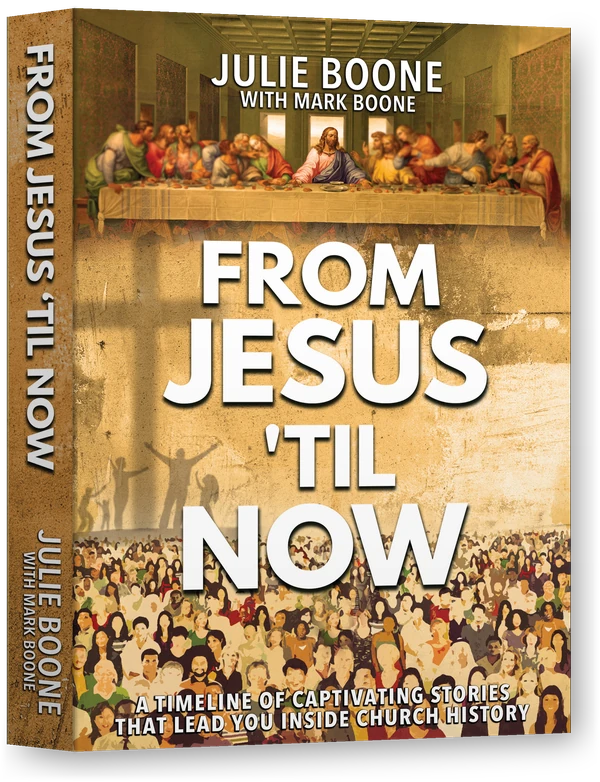
By Julie Boone · In cooperation with Mark Boone
From Jesus 'til Now
A Timeline of Captivating Stories That Lead You Inside Church History
For adult Sunday school classes, small groups and any believer who has found history dull.
A storyteller's timeline of the Christian church from Pentecost to the iPhone century, in twenty-four chapters that each end with Bible study and questions to talk through together.
15% off first order + free standard shipping to 223 countries
Afghanistan, Åland Islands, Albania, Algeria, Andorra, Angola, Anguilla, Antigua And Barbuda, Argentina, Armenia, Aruba, Australia, Austria, Azerbaijan, Bahamas, Bahrain, Bangladesh, Barbados, Belgium, Belize, Benin, Bermuda, Bhutan, Bolivia, Bosnia And Herzegowina, Botswana, Brazil, Brunei Darussalam, Bulgaria, Burkina Faso, Burundi, Cambodia, Cameroon, Canada, Cape Verde, Caribbean Netherlands, Cayman Islands, Central African Republic, Chad, Chile, China, Colombia, Comoros, Cook Islands, Costa Rica, Cote D'ivoire, Croatia (Local Name: Hrvatska), Curaçao, Cyprus, Czech Republic, Denmark, Djibouti, Dominica, Dominican Republic, Ecuador, Egypt, El Salvador, Equatorial Guinea, Eritrea, Estonia, Ethiopia, Falkland Islands (Malvinas), Faroe Islands, Fiji, Finland, France, French Guiana, French Polynesia, Gabon, Gambia, Georgia, Germany, Ghana, Gibraltar, Greece, Greenland, Grenada, Guadeloupe, Guam, Guatemala, Guernsey, Guinea, Guinea-Bissau, Guyana, Haiti, Holy See (Vatican City State), Honduras, Hong Kong, Hungary, Iceland, India, Indonesia, Iraq, Ireland, Isle of Man, Israel, Italy, Jamaica, Japan, Jersey, Jordan, Kazakhstan, Kenya, Kiribati, Kuwait, Kyrgyzstan, Lao People's Democratic Republic, Latvia, Lebanon, Lesotho, Liberia, Libyan Arab Jamahiriya, Liechtenstein, Lithuania, Luxembourg, Macao, Macedonia, The Former Yugoslav Republic Of, Madagascar, Malawi, Malaysia, Maldives, Mali, Malta, Martinique, Mauritania, Mauritius, Mayotte, Mexico, Moldova, Republic Of, Monaco, Mongolia, Montenegro, Montserrat, Morocco, Mozambique, Myanmar, Namibia, Nauru, Nepal, Netherlands, New Caledonia, New Zealand, Nicaragua, Niger, Nigeria, Niue, Norway, Oman, Pakistan, Palestinian Territory, Occupied, Panama, Papua New Guinea, Paraguay, Peru, Philippines, Pitcairn, Poland, Portugal, Puerto Rico, Qatar, Republic of Korea, Reunion, Romania, Rwanda, Saint Barthélemy, Saint Kitts And Nevis, Saint Lucia, Saint Martin, Saint Vincent And The Grenadines, Samoa, San Marino, Sao Tome And Principe, Saudi Arabia, Senegal, Serbia, Seychelles, Sierra Leone, Singapore, Sint Maarten, Slovakia (Slovak Republic), Slovenia, Solomon Islands, Somalia, South Africa, Spain, Sri Lanka, St. Helena, St. Pierre And Miquelon, Sudan, Suriname, Svalbard And Jan Mayen Islands, Swaziland, Sweden, Switzerland, Taiwan, Tajikistan, Tanzania, United Republic Of, Thailand, Timor-Leste, Togo, Tokelau, Tonga, Trinidad And Tobago, Tunisia, Turkey, Turkmenistan, Turks And Caicos Islands, Tuvalu, Uganda, Ukraine, United Arab Emirates, United Kingdom, United States, Uruguay, Uzbekistan, Vanuatu, Viet Nam, Virgin Islands (British), Wallis And Futuna Islands, Western Sahara, Yemen, Zambia, Zimbabwe
Two thousand years of church history, told through the people who lived it.
History can be eye-opening, as when we realize that only 1 in 10 people living in Rome in Jesus' lifetime knew how to read, and that books (including the Bible itself) have been widely available to nurture faith for less than six hundred years.
For adult Sunday school classes, small groups and any believer who has found history dull. Julie Boone walks from Pentecost to the iPhone century in twenty-four chapters, with martyrs, monks, scholars, reformers and missionaries, and every chapter ends with Bible study and questions you can talk through together.
What makes this book for readers who want church history they can actually enjoy
A church history that reads like stories, and a study guide that sends you back to Scripture. It begins in the world of the Bible, which the introduction says is "geographically a good bit larger than the typical Holy Land tourist imagines," and it keeps going until now.
Five things set it apart:
- It is told through people. Each chapter details a period of church history "and the people who were notable in it," from Origen and Augustine to John Newton, William Wilberforce and John Woolman.
- It is honest about failure. The introduction calls church history "a story of great faith lived out in challenges, of great fears overcome by faith, and sometimes – when we're honest -- of great failures by those who thought they were trying to do God's will."
- It ends every chapter with something to do. Questions for thought and discussion, a Bible passage to study, questions for your response, and internet keywords to search if you want to go further.
- It is built for a group. The questions compare the historic issues in the chapter with issues "that may be experienced in the contemporary church," which makes it easy to use in a class or small group.
- It is a mother's life work. Julie Boone spent much of her life developing the text, and her son, Mark Boone, saw it into print after she passed into glory.
About the author
Written by
Julie Boone
Published by
 Spirit Media Publishing

Julie Boone
Julie Boone spent much of her life developing From Jesus 'til Now, a storyteller's timeline of the Christian church written to help believers learn its history and draw lessons for church life today. The book was completed in cooperation with her son, Mark Boone, who saw it through to publication after she passed into glory.
Spirit Media Publishing
Spirit Media Publishing is a Christian publishing and marketing company with a vision to reveal our Father's heart to all nations. It offers full-service book creation and publishing in paperback, hardback, digital and audiobook formats, along with children's titles, compact Express Books, website design and SEO, and podcast and video production. We are honored to publish Julie Boone's life work, seen into print by her son.
What's inside
- A storyteller's timeline of the Christian church, from Pentecost to the iPhone century
- An introduction, a short guide called How to Use This Book, and a prologue with Alexander the Great at the gates of Jerusalem
- Twenty-four chapters, from the early church and the Nicene Creed to the Crusades, the Reformation and the missionaries
- At the end of every chapter: questions for thought and discussion, a Bible passage to study, questions for your response and internet keywords for further research
- Short biographies throughout, a conclusion and an index of names and topics
- Paperback and hardback editions, 6 x 9 inches, 388 pages
Product details
- Title
- From Jesus 'til Now
- Paperback ISBN
- 978-1-958304-43-3
- Hardback ISBN
- 978-1-958304-44-0
- eBook ISBN
- 978-1-958304-45-7
- Subtitle
- A Timeline of Captivating Stories That Lead You Inside Church History
- Author
- Julie Boone, in cooperation with Mark Boone
- Publisher
- Spirit Media Publishing
- Language
- English
- Pages
- 388
- Trim size
- 6 x 9 inches
- Binding
- Paperback (perfect bound) and hardback
- Library of Congress Control Number
- 2023900212
For adult Sunday school classes and small groups
Each chapter gives a class what it needs in one sitting: a stretch of history to read, discussion questions to talk through, a Bible passage and a personal response. The questions ask things like what you would say to a person of another faith about the value of the meetings at your church, and what your church does with the money it collects.
For believers who have found history dull
If school made church history feel like names and dates, this is a different kind of book. You will meet Origen, whose mother hid his clothes to keep him from rushing out to be martyred, and Augustine, who first went to church to study a preacher's speaking style. Alexander the Great bows to a high priest in the prologue. The details are the point.
For readers who want real stories of martyrs, monks, scholars, crusaders and missionaries
The chapters range from the early church and its persecutions to the Nicene Creed, from monasteries to the Crusades, from the plague and the mystics to the Reformation and the missionaries who went to the far corners of the world. A long chapter on "Amazing Grace" follows John Newton, William Wilberforce and John Woolman, and the closing chapters bring the story into the iPhone century.
For readers who want to know how the creeds and the Reformation came about
Chapter Three explains the decisions made at the Nicene Convention and how the Nicene Creed was written, and why the Apostles' Creed became even more popular. Chapter Fourteen, The Fabulous Sixteenth, follows Martin Luther from his early years and shows how Bibles in the language of the people could at last be bought legally. The book is plain that the reformers wanted change long before it came.
Three stories from the book
The king who bowed to a priest
When Alexander the Great reached Jerusalem, the high priest was frantic with fear that he would destroy the city. That night he saw in a dream the gates open, the people in white and the priests in their robes, and he asked everyone to recreate the scene. Alexander stopped his army, rode up alone, dismounted and bowed. Asked by an officer why he, before whom people showed adoration, would honor a priest, he replied that he honored, not the priest, but the God the priest worshiped. Jerusalem was not attacked.
Origen's mother hid his clothes
Origen was born in Egypt around A.D. 185 and tutored by his father, and he learned to quote long passages from the Bible when he was only a boy. He asked so many questions that his father reproved him for being too inquisitive, yet "secretly thanked God for such a child." When Origen was seventeen, his father was arrested and killed because of his faith. The youth tried to join his father in death, but his mother kept him home by hiding his clothes. He went on to head a Christian school in Alexandria and to compile the Hexapla, a massive book of Bible translations set in parallel columns.
The son of those tears
Augustine preferred the theater to church, and his mother, Monica, prayed and wept almost continuously for him. She asked a priest to talk with him, and he answered, "Leave me and go in peace. It cannot be that the son of those tears should be lost." In Milan, Augustine began attending Ambrose's church only to study his eloquence, then found he could not ignore the meaning. The book prints Augustine's own account of weeping beneath a fig tree: "How long shall I go on saying 'tomorrow, tomorrow'? Why not now?" Then a child's voice nearby chanted, "Take it and read, take it and read."
Why this book exists
The book exists so that readers can "both learn about the history of God's church and discover lessons from church history for church life today." In his introduction, Mark Boone writes that "helping you to find, reflect on, and make good use of those lessons is a primary goal of this book."
The conclusion is humble about it. "People usually think the time in which they live has unique challenges never before overcome," it begins, and it adds that monasteries, the Reformation and revivals "solved some problems and created others." Its closing hope is: "By God's grace, may each of us live closer to God's purposes for our own times."
Questions
What is From Jesus 'til Now about?
A guided walk through two thousand years of the Christian church, from Pentecost to the iPhone century, told through real people in twenty-four chapters.
Is it a Bible study guide?
It is church history with study tools. Every chapter ends with questions for thought and discussion, a Bible passage to study, questions for your response and internet keywords to search for further study.
Does it work for a small group Bible study?
Yes. How to Use This Book says the questions compare the issues in each chapter with issues that may be experienced in the contemporary church, which makes each chapter easy to use for one meeting of a class or small group.
Does it cover the book of Acts and the early Christians?
Yes. Chapter One, The Genesis of the Church, starts with Luke's account in Acts, from Jesus' last visit with his disciples to Pentecost, and Chapters Two and Three follow the early Christians through rumors, persecution and, at last, power.
Does it tell the story of Saint Augustine?
Yes. Chapter Five tells how Augustine preferred the theater to church, how his mother prayed for him, and how he went to hear Ambrose preach in Milan and was converted.
What does it say about the Nicene Creed?
Chapter Three explains the decisions made at the Nicene Convention and how the Nicene Creed was written. It adds that the unity it set forth did not last long, and that the Apostles' Creed became even more popular.
Does it cover the Protestant Reformation?
Yes. Chapter Fourteen, The Fabulous Sixteenth, tells of the reformers before the Reformation and of Martin Luther, from his early years on. Later chapters follow the changes that came after it.
Does it cover the Crusades?
Yes. Chapter Eleven is The Crusades. It tells why people joined them and does not soften what happened: "Tragic is far too small a word for the crusades. They created hate and destruction."
How is each chapter organized?
Each chapter tells the history of a period and its notable people, then offers questions for thought and discussion, a Bible study passage, questions for your response and internet keywords to search for further study.